A short history of tonkatsu
Tonkatsu has no known inventor. What the records show, what rests on restaurants' own accounts, and which popular claims we do not repeat.
Tonkatsu has no known inventor. Several Tokyo restaurants claim a part in its story, and none of those claims can be confirmed from documents of the time. What the records do show is a dish that took shape slowly, in more than one place.
The word came first
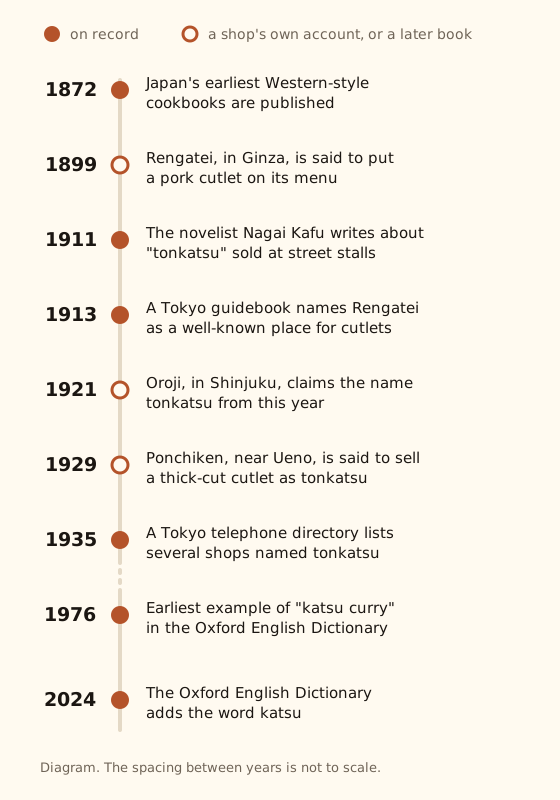
The word is older than the dish. Japanese katsuretsu comes from the French côtelette by way of the English cutlet, and Japan's earliest Western-style cookbooks were published in 1872.[1][2][3][4]
Ginza, 1899: the usual starting point
Rengatei, a restaurant in Ginza that dates its founding to 1895, is widely credited with putting a pork cutlet on its menu in 1899. We have not found a menu, advertisement or newspaper from those years that confirms the date. What we can confirm is later: a Tokyo guidebook published in 1913 names Rengatei as a well-known place for cutlets.[5][6][7]
1911: the word tonkatsu in print
The earliest use of the word tonkatsu that we have read ourselves is from July 1911. The novelist Nagai Kafu wrote about tonkatsu sold at street stalls in Tokyo, and described the stall's fried pork as something new: no longer Western food, and not tempura either.[8]
1929: the thick cut
The usual story points to a shop called Ponchiken, near Ueno, which is said to have begun selling a thick-cut pork cutlet as tonkatsu in 1929. A former Imperial Household cook, Shimada Shinjiro, is often named as the creator. Kafu's essay shows the word was in print 18 years earlier. If the 1929 account is right, it describes the start of a thick-cut specialty, not the birth of the name. Oroji, a restaurant in Shinjuku, also claims the name, from 1921.[9][10][8]
By the early 1930s, specialist shops are said to have clustered around Ueno and Asakusa. A Tokyo business telephone directory from 1935 lists several shops with tonkatsu in their names.[9][11]
Relatives, not parents
Wiener schnitzel and cotoletta alla milanese belong to the same European family of breaded cutlets. We have found no record that either one travelled to Japan directly, so we call them relatives of tonkatsu, not its parents. Korean dongaseu is thought to have arrived from Japan in the 1930s, and its name is generally explained as a borrowing of the Japanese word.[12]
The word goes home
The word has since gone home. In March 2024 the Oxford English Dictionary added katsu. Its earliest example is the compound katsu curry, from 1976. The dictionary calls katsu a boomerang word: English cutlet went to Japan, and came back as katsu.[2]
What we have not checked yet
- Okada Tetsu's book on the birth of tonkatsu, which most accounts of 1899 and 1929 rely on. We have only seen it quoted by others.
- The earliest citation for tonkatsu in the Nihon Kokugo Daijiten, Japan's largest dictionary.
- A reported mention of a pork cutlet in an 1890 Tokyo guidebook, which would be earlier than Rengatei's 1899.
Sources
Where the only evidence is a shop's or a producer's own account, we write "is said to" and do not state it as fact.
- Secondary source コトバンク「カツレツ」
https://kotobank.jp/word/カツレツ-45234 - Primary source Oxford University Press 報道発表文(2024-03-26)
https://www.infodocket.com/wp-content/uploads/2024/03/US-OED-Japanese-update-March-2024-PR.pdf - Secondary source 国立国会図書館 電子展示「近代日本とフランス」コラム
https://www.ndl.go.jp/france/jp/column/s2_1.html - Primary source 『西洋料理通 後編(附録)』国立国会図書館デジタルコレクション
https://dl.ndl.go.jp/pid/1084635 - Supporting material 飲食店ドットコム Foodist(店主談)
https://www.inshokuten.com/foodist/article/5334 - Supporting material さんたつ
https://san-tatsu.jp/articles/88833/ - Primary source 湯浅観明『通人物語 趣味の東京』(鈴木書店、1913)
https://dl.ndl.go.jp/pid/906698/1/130 - Primary source 永井荷風「銀座」青空文庫
https://www.aozora.gr.jp/cards/001341/card49640.html - Supporting material Wikipedia「豚カツ」(岡田哲『とんかつの誕生』p.172 を引く)
https://ja.wikipedia.org/wiki/豚カツ - Primary source 『職業別電話名簿』第24版
https://dl.ndl.go.jp/pid/1142887/1/1111 - Primary source 『職業別電話名簿』第25版(1935)
https://dl.ndl.go.jp/pid/1112313/1/563 - Supporting material Wikipedia "Dongaseu"
https://en.wikipedia.org/wiki/Dongaseu
Checked on: 2026-10-13