Reading the pork on a tonkatsu menu
Breed, cross, SPF, brand, aged, jo. The words on a tonkatsu menu are not all the same kind of word. What each one tells you, and what it does not.
A tonkatsu menu can name a breed, a way of breeding, a farm standard, a producer's brand and a way of aging the meat, all in the same line and all looking like the name of the pork. They are different kinds of word, and each tells you something different. This page sorts them out.[1]
The cuts
Start with the cut, because it decides more about your meal than any other word on the menu. Japan's official trading standard for pork divides a half carcass into five cuts: shoulder, fillet, loin, belly and leg. Tonkatsu shops work almost entirely with two of them. rosu is the loin, cut from along the back and trimmed to leave a layer of fat on one side. hire is the fillet, trimmed of all its outer fat. Around Osaka the same cut is often written here.[2]
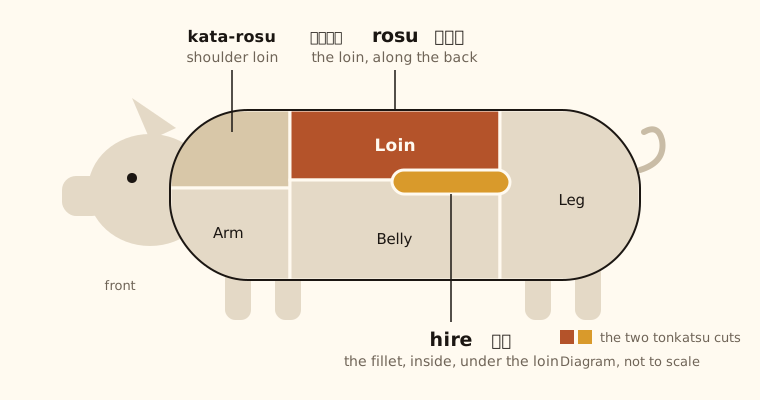
Many menus go further, with words such as ribu-rosu, upper loin or shatoburian. These are the shops' own names. The official standard has a shoulder loin, kata-rosu, but no rib loin, and what each shop means by these words is reported to differ from shop to shop. One Tokyo shop, Narikura, lists the thick centre of the fillet under a pun on chateaubriand. If the difference matters to you, ask what the cut is, or look at the weight printed beside it.[3][2]
| On the menu | ||
|---|---|---|
| ロース | rosu | The loin: the cut from along the back, with a strip of fat on one edge. The standard order at most tonkatsu shops. |
| ヒレ | hire | The fillet (tenderloin): a lean, tender muscle from inside the loin, with almost no fat. |
| ヘレ | here | Another spelling of hire (fillet), seen on menus in the Kansai region around Osaka. |
| 肩ロース | kata-rosu | The shoulder end of the loin. It carries more fat, running through the meat as well as around it. |
| リブロース | ribu-rosu | A shop's name for the fattier end of the loin, nearer the shoulder. It is not one of the cuts in Japan's official trading standard, so where it begins and ends depends on the shop. |
| シャトーブリアン | shatoburian | A term borrowed from beef for the thick centre of the fillet. A shop's own name, with no official definition for pork. |
Breeds and crosses
sangenton is the word most likely to be mistaken for a brand. It is a breeding method. Most pigs raised for meat in Japan are a three-way cross: a sow that is half Landrace and half Large White, mated with a Duroc boar. A menu that says sangenton is telling you the pork is a standard Japanese cross.[4]
kurobuta, "black pig", is a breed name with a rule behind it. In Japan, only pork from purebred Berkshire pigs may be labelled kurobuta. The best-known kurobuta comes from Kagoshima, in the far south, where the black pig is said to have arrived from the Ryukyu islands about 400 years ago and was later improved by crossing with British Berkshires. By 1975 it had fallen to 1.6 percent of the prefecture's pork shipments.[1][5]
Some names are both a brand and a breed of their own. Tokyo X is one. It was developed by Tokyo's livestock research station from three breeds, Beijing Black, Berkshire and Duroc, over five generations, and certified as a line in 1997. About 10,000 head a year reach the market.[6]
Words that are easy to misread
SPF stands for Specific Pathogen Free. It means the pig came from a farm free of five named diseases: swine enzootic pneumonia, atrophic rhinitis, swine dysentery, toxoplasmosis and Aujeszky's disease. It is a standard for the farm, not a breed. A three-way cross or a Berkshire can equally be SPF pork. It does not mean the pork is sterile, and we found no official source that says it tastes better.[1]
meigara-buta, brand pork, covers a great deal. Japan has more than 400 named pork brands, and we found no single official definition of what a brand must be. The word on its own does not tell you the breed or the feed.[7]
jukusei, aged, is not a breed or a brand. It is something done to the meat after slaughter. How much it changes the meat depends on temperature and time: one study at Kansai University found that loin aged at minus 1 degree Celsius for 42 days had more glutamic acid than loin aged at 4 degrees for 14 days, and was preferred in tasting.[8]
| On the menu | ||
|---|---|---|
| 黒豚 | kurobuta | "Black pig". In Japan the name may be used only for pork from purebred Berkshire pigs. |
| 三元豚 | sangenton | A three-way cross: the standard way commercial pigs are bred in Japan. It describes a breeding method, not a brand. |
| SPF豚 | SPF | Specific Pathogen Free: pork from farms certified free of five named pig diseases. A farm health standard, not a breed and not a grade of flavour. |
| 銘柄豚 | meigara-buta | Brand pork: pork sold under a producer's or region's name. Each brand sets its own rules, so the label alone does not tell you the breed or the feed. |
| 熟成 | jukusei | Aged. The meat has been rested at low temperature after slaughter. It describes handling, not a breed or a brand. |
Menu tiers are not official grades
Japan does have official grades for pork. There are five, called gokujo, jo, chu, nami and togai, and they are given to a whole carcass for trading. The grade checks whether the carcass falls within set ranges of weight and back fat, along with its appearance and meat quality. For the top grade the range is 73 to 81 kilograms and 1.5 to 2.1 centimetres of back fat. In 2024 the top grade went to 0.2 percent of carcasses, and the most common grade was jo, at a little under half.[9][10]
The trouble is that tonkatsu menus use some of the same words. jo, tokujo and tokusen on a menu appear to be each shop's own tiers. We found no document linking these menu tiers to the official grades. Read them as "this shop's higher tier", and compare the weight and the price.[9]
Fat: what is measured and what is advertising
Many brands describe their fat as sweet, or as melting at a low temperature. Most of these are the producers' own descriptions, given without measurements. What research stations in Japan have measured points somewhere else: their studies repeatedly show that feed changes the make-up and the melting point of pork fat. In one trial in Wakayama, a feed additive raised the melting point of the back fat from 37 to 47 degrees Celsius. Breed is only part of the story.[5][11][12]
How we use this in our reviews
In our reviews the pork is worth 30 of the 100 points. We describe the fat by what we tasted, not by the reputation of the brand. And because a shop can change its pork, we record the pork as what was served on the day we visited, with the date.
What we have not checked yet
- Whether shops use the official grade as a condition when buying pork. We have not asked any shops yet.
- The Japan SPF Swine Association's own wording of the standard and how farms are certified. We relied on a Tokyo government explanation.
- The text of the labelling rule that reserves kurobuta for purebred Berkshire.
- Peer-reviewed studies comparing the melting point of fat between breeds. The studies we cite are research-station reports.
Sources
Where the only evidence is a shop's or a producer's own account, we write "is said to" and do not state it as fact.
- Secondary source 東京都芝浦食肉衛生検査所 Q&A(SPF、黒豚)
https://www.hokeniryo.metro.tokyo.lg.jp/sibaura/chishiki/niku_qa/other/qa10.html - Secondary source 日本食肉格付協会 豚部分肉取引規格
https://www.jmga.or.jp/standard/pork-partial/ - Supporting material 成蔵(ヒトサラの掲載)
https://hitosara.com/0006086568/ - Secondary source 鳥取県(止め雄とLWDの肉質)
https://www.pref.tottori.lg.jp/secure/1241733/H29-02tomeLWDniku.pdf - Secondary source 鹿児島県 かごしま黒豚
https://www.pref.kagoshima.jp/ag01/sangyo-rodo/nogyo/nosanbutu/brand/kurobuta.html - Secondary source 東京都(TOKYO X の資料)
https://www.sangyo-rodo.metro.tokyo.lg.jp/plan/nourin/chikusan/pdf/chap2-1-4.pdf - Secondary source JETRO 日本の豚肉
https://www.jetro.go.jp/agriportal/pickup/pork - Secondary source 関西大学(豚ロースの氷温熟成)
https://kansai-u.repo.nii.ac.jp/record/19725/files/KU-1100-20210331-01.pdf - Secondary source 日本食肉格付協会 豚枝肉取引規格
https://www.jmga.or.jp/standard/pork/ - Secondary source ALIC(規格改正、等級の分布)
https://www.alic.go.jp/joho-c/joho05_003117.html - Secondary source 和歌山県(飼料と脂肪の融点)
https://www.pref.wakayama.lg.jp/prefg/070100/070109/kanko/h26joho_d/fil/h26seikajoho_19.pdf - Secondary source 愛知県畜産総合センター(融点とリノール酸)
https://www.pref.aichi.jp/uploaded/attachment/371023.pdf
Checked on: 2026-10-13