Tonkatsu's relatives around the world
Schnitzel, cotoletta, kotlet schabowy, Shanghai's fried pork chop and more. How each one relates to tonkatsu, and how much of each story is on record.
Tonkatsu is one of a family of dishes: a single piece of meat, coated in breadcrumbs, then fried. We sort the family into three groups. An ancestor is where the word and the idea came from. A relative is a dish from the same tradition, with no record that it reached Japan directly. A descendant is a dish that grew out of tonkatsu itself.
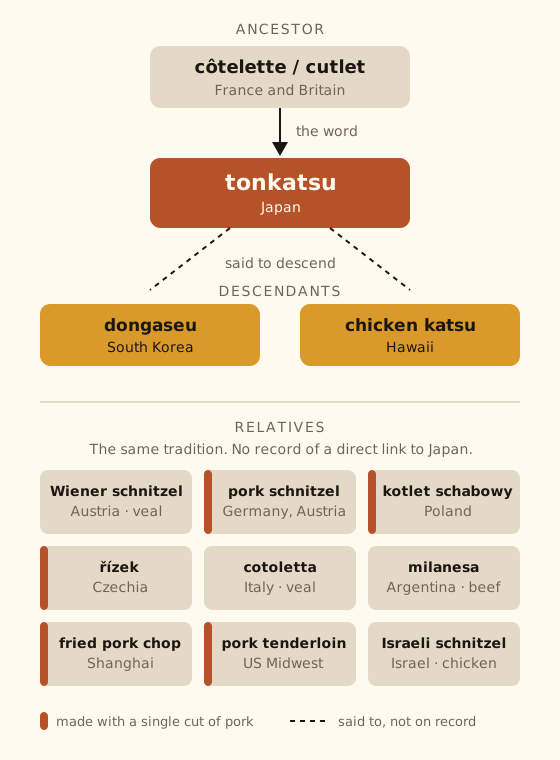
| Dish | Where | Meat | How it relates to tonkatsu | A single cut of pork |
|---|---|---|---|---|
| Côtelette and cutlet côtelette / cutlet | France and Britain | Veal, Lamb | Ancestor | No |
| Wiener schnitzel Wiener Schnitzel | Austria | Veal | Relative | No |
| Pork schnitzel Schnitzel Wiener Art | Germany and Austria | Pork | Relative | Yes |
| Kotlet schabowy kotlet schabowy | Poland | Pork | Relative | Yes |
| Řízek řízek | Czechia | Pork, Veal, Chicken | Relative | Yes |
| Cotoletta alla milanese cotoletta alla milanese | Italy | Veal | Relative | No |
| Milanesa milanesa | Argentina and Latin America | Beef, Chicken | Relative | No |
| Shanghai fried pork chop 炸猪排 | Shanghai | Pork | Relative | Yes |
| Pork tenderloin sandwich pork tenderloin sandwich | US Midwest | Pork | Relative | Yes |
| Israeli schnitzel שניצל | Israel | Chicken, Turkey | Relative | No |
| Dongaseu 돈가스 | South Korea | Pork | Descendant | Yes |
| Hawaiian chicken katsu chicken katsu | Hawaii | Chicken | Descendant | No |
The ancestor: côtelette and cutlet
The Japanese word katsuretsu comes from the French côtelette by way of the English cutlet, and katsu is its short form. That is the one line of descent we can state plainly. The rest of this page is about cousins.[1][2]
Vienna, and the rule about veal
The Wiener schnitzel is the relative most people think of first, and it is a relative, not a parent. We have found no record that it travelled to Japan directly. In its home countries the name has a fixed meaning: under the guidelines of Germany's food code, a Wiener schnitzel is a breaded schnitzel of veal. Pork versions are sold as "Schnitzel Wiener Art", Viennese style, in Germany, and as "Wiener Schnitzel vom Schwein", of pork, in Austria, according to a German legal commentary.[3][4]
Schnitzel has its own origin legend: that Field Marshal Radetzky brought the recipe to Vienna from Milan. That story is now treated as a legend. Milan, for its part, points to a banquet menu from 1134 as the origin of its cotoletta alla milanese, a reading that is disputed.[5][6]
Poland and Czechia: the pork cousins
Poland's kotlet schabowy is the closest relative in form: a pork loin cutlet. It is said to have arrived in the nineteenth century as a pork version of the Viennese schnitzel, and to have become a staple of state-run canteens after the Second World War. One thing is on record. A Polish cookbook printed in 1871, the eighth edition of Lucyna Ćwierczakiewiczowa's "365 Dinners", has a recipe for pork cutlets: bone-in loin, pounded, dipped in beaten egg and breadcrumbs, and fried in butter or lard.[7][8]
The Czech řízek, made with pork, veal or chicken, is said to have taken hold in the nineteenth and twentieth centuries and to have become a fixture of Sunday lunch.[9]
Shanghai: the same change, made separately
Shanghai has a fried pork chop of its own. The city government's website describes Shanghai-style Western food as born in the early twentieth century, when local cooks adapted European dishes, and names the fried pork chop, borscht and potato salad as its three staples. The chop is pounded, coated in flour, egg and breadcrumbs, fried, and served with a local Worcestershire-style sauce.[10]
Where the dish came from is less settled. Shanghai newspapers describe it as a Viennese veal cutlet remade with pork, while other accounts trace it through Britain. The sauce, la jiangyou, is said to be the local name for English Worcestershire sauce, first imported by restaurants in the foreign concessions at the end of the nineteenth century. A port city, Western restaurants, pork in place of veal, a Worcestershire-style sauce: the parallels with Japan are close. We have found nothing to show that one came from the other, so we treat them as the same change made twice.[11][12]
The American Midwest
In Indiana and its neighbours, the cutlet went into a bun. The breaded pork tenderloin sandwich is credited to Nick's Kitchen in Huntington, Indiana, said to have been opened in 1908 by the son of German immigrants. Every account we have read presents this as the shop's claim.[13]
Relatives made with other meat
Argentina's milanesa, usually beef or chicken, is said to have come with Italian immigrants between the 1860s and the 1920s. The version topped with ham, cheese and tomato, the milanesa napolitana, is said to have been invented in a Buenos Aires restaurant in the 1940s; it is not a dish from Naples. Israeli schnitzel is said to have been brought by immigrants from central Europe, who used chicken and turkey in place of veal. Because Jewish dietary law keeps meat and dairy apart, it is fried in oil, not butter.[14][15][16][17]
The descendants: Korea and Hawaii
Two dishes on this page came from tonkatsu, not alongside it. Korean dongaseu is thought to have arrived from Japan in the 1930s, and its name is generally explained as a borrowing of the Japanese word. Hawaii's chicken katsu is said to descend from the tonkatsu that Japanese immigrants brought with them, later made with chicken and now a staple of the plate lunch. We found no record of when the chicken version first appeared.[18][19]
A note on origin stories
For almost every dish on this page, the account of who made it first rests on tradition, not on documents from the time. Tonkatsu is the same. We repeat these stories as stories, and say so each time.
What we have not checked yet
- The text of the German and Austrian food codes themselves. We have read a Bavarian state agency's explanation, not the code.
- Whether the first edition of the Polish cookbook, from 1860, already had the pork cutlet recipe. We checked the 1871 edition.
- What Shanghai's local gazetteers say about the sauce. We have only seen them quoted.
- Okada Tetsu's book on the birth of tonkatsu, which most accounts of 1899 and 1929 rely on. We have only seen it quoted by others.
- The earliest citation for tonkatsu in the Nihon Kokugo Daijiten, Japan's largest dictionary.
- A reported mention of a pork cutlet in an 1890 Tokyo guidebook, which would be earlier than Rengatei's 1899.
Sources
Where the only evidence is a shop's or a producer's own account, we write "is said to" and do not state it as fact.
- Secondary source コトバンク「カツレツ」
https://kotobank.jp/word/カツレツ-45234 - Primary source Oxford University Press 報道発表文(2024-03-26)
https://www.infodocket.com/wp-content/uploads/2024/03/US-OED-Japanese-update-March-2024-PR.pdf - Secondary source バイエルン州保健・食品安全局(LGL)
https://www.lgl.bayern.de/lebensmittel/warengruppen/wc_07_fleischerzeugnisse/et_schnitzel_schnitten.htm - Supporting material Rechtslupe(ドイツの法律解説)
https://www.rechtslupe.de/wirtschaftsrecht/wiener-schnitzel-vom-schwein-314308 - Secondary source オーストリア農林省 伝統食品「Wiener Schnitzel」
https://www.bmluk.gv.at/themen/lebensmittel/trad-lebensmittel/speisen/wiener_schnitzel.html - Supporting material Rolling Stone Italia
https://www.rollingstone.it/cultura/che-storia-la-cotoletta/1007367/ - Supporting material Culture.pl
https://culture.pl/en/article/a-joke-an-icon-the-classic-polish-pork-cutlet - Primary source 『365 obiadów za 5 złotych』1871年第8版「Kotlety wieprzowe」(ウィキソースの翻刻)
https://pl.wikisource.org/wiki/365_obiadów_za_5_złotych/Kotlety_wieprzowe - Supporting material Expats.cz
https://www.expats.cz/czech-news/article/from-vienna-to-prague-how-schnitzel-rizek-became-a-czech-comfort-food - Secondary source 上海市 英語公式サイト
https://english.shanghai.gov.cn/en-GlobalTasteinShanghai2026-LocalFlavors/20260529/0d3848e86e284eee89286f672fec4ce4.html - Supporting material 澎湃新聞(上海の西洋料理)
https://m.thepaper.cn/baijiahao_15885874 - Supporting material sspai(辣醤油の歴史)
https://sspai.com/post/76845 - Supporting material インディアナ州観光局
https://visitindiana.in.gov/blog/post/this-diner-is-where-the-breaded-pork-tenderloin-originated/ - Secondary source ブエノスアイレス市観光局
https://turismo.buenosaires.gob.ar/en/article/truth-milanesa - Supporting material Wikipedia: Milanesa
https://en.wikipedia.org/wiki/Milanesa - Supporting material My Jewish Learning
https://myjewishlearning.com/?p=136264 - Supporting material Aish
https://aish.com/what-makes-schnitzel-so-revolutionary-in-israeli-cuisine/ - Supporting material Wikipedia "Dongaseu"
https://en.wikipedia.org/wiki/Dongaseu - Supporting material Wikipedia: Plate lunch
https://en.wikipedia.org/wiki/Plate_lunch
Checked on: 2026-10-13